
Key Takeaways
- There is no automatic 50/50 asset split in divorce settlements in Australia.
- Australian family law courts assess contributions, future needs, and fairness when dividing property.
- The property pool can include assets, debts, superannuation, businesses, and trusts.
- Property settlements can be resolved through negotiation, mediation, consent orders, or court proceedings.
- Early legal advice and proper financial disclosure can help achieve a fair and efficient outcome.
What really affects property settlement outcomes?
Property settlement in Australia is not based on a fixed formula or automatic 50/50 split. Under the Family Law Act 1975, courts assess each relationship individually by examining the total asset pool, the financial and non-financial contributions made by each party, and their respective future needs. This applies to both married and de facto couples following separation or divorce.
Key principles courts consider:
- The full value of the asset and liability pool
- Financial and non-financial contributions by each party
- Homemaker and parenting contributions
- Future needs, including income and care of children
- Whether the proposed settlement is fair overall
What factors determine your property division?
Australian family law courts use a structured process when determining how assets are divided after separation or divorce. Rather than applying a fixed percentage split, courts assess each relationship individually to determine what outcome is fair and equitable under the Family Law Act 1975.
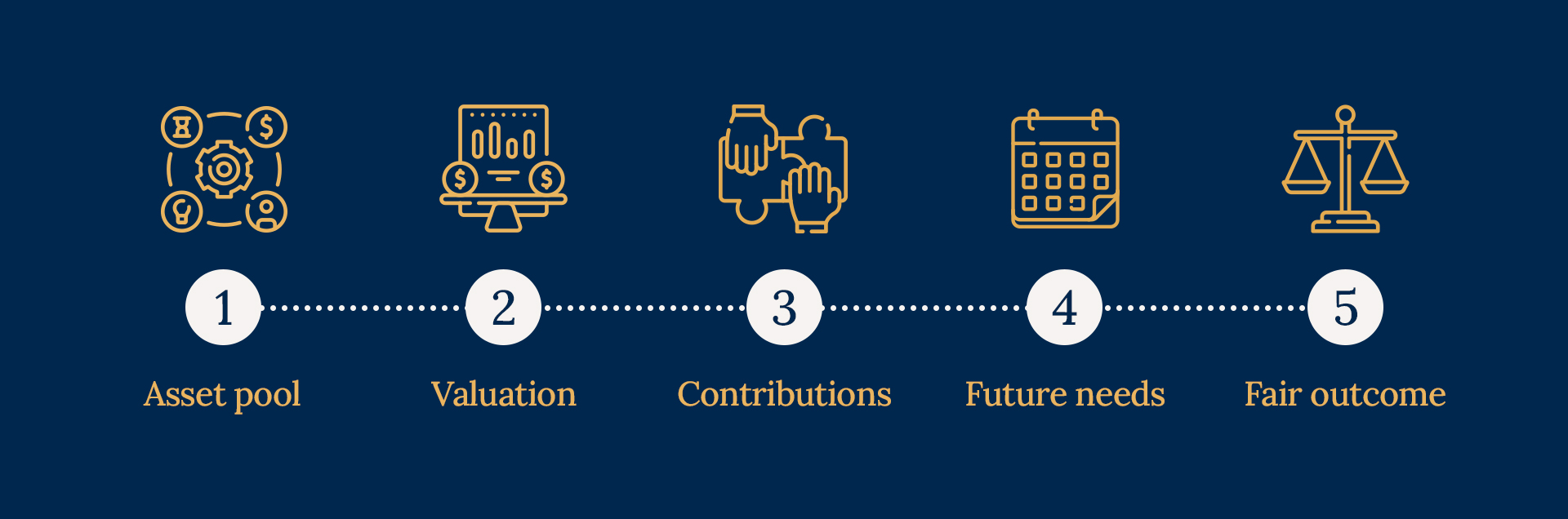
Identify the asset pool
The first step is identifying all assets, liabilities, superannuation, businesses, trusts, and financial resources belonging to both parties. This may include jointly owned and individually owned property.
Assess the value of assets and liabilities
Courts then assess the current value of the property pool at the time of settlement negotiations, mediation, or court proceedings rather than at the date of separation.
Consider contributions by each party
The court examines financial and non-financial contributions made throughout the relationship, including income, property ownership, homemaking, parenting responsibilities, and contributions toward businesses or investments.
Adjust for future needs and fairness
Future needs are then considered, including income disparity, health issues, age, care of children, and earning capacity. The court will ultimately assess whether the proposed property settlement is fair overall.
What are the steps to divide property in a divorce or separation?
Property settlement in Australia usually follows a structured process designed to identify assets, assess financial circumstances, and formalise a fair agreement between both parties. While many matters resolve through negotiation or mediation, the same general process applies whether settlement occurs privately or through the Family Court.
- 01

Financial disclosure
Both parties exchange information about their financial circumstances, including assets, liabilities, income, superannuation, businesses, trusts, and other financial resources.
- 02

Property and asset valuation
Assets and liabilities are then valued based on their current market value. This may include real estate, businesses, vehicles, investments, superannuation, and shared debts.
- 03

Negotiation or mediation
The parties may attempt to resolve the property settlement through negotiation, mediation, or family dispute resolution, with assistance from divorce lawyers or other professionals.
- 04

Formalising the agreement
If an agreement is reached, it can be formalised through consent orders or a financial agreement to provide legal certainty and finality.
- 05

Implementing the property settlement
Once the agreement or court orders are finalised, assets may be transferred, liabilities refinanced, superannuation split, and financial arrangements completed.
What is my wife entitled to in a divorce?
There is no automatic rule in Australia that a wife is entitled to 50% of the assets in a divorce settlement. Under Australian family law, property division is based on each party’s financial and non-financial contributions, future needs, and what the court considers fair in the circumstances of the relationship.
The court will assess the total asset pool, including property, superannuation, businesses, investments, and liabilities, before determining an appropriate division of assets between the parties.
Examples of factors that may affect entitlement:
- Financial contributions such as income, property ownership, inheritances, or business involvement
- Non-financial contributions including homemaking and caring for children
- Future needs factors such as earning capacity, health, age, and ongoing care responsibilities
What am I entitled to in a divorce in Australia?
Your entitlement in a divorce or property settlement depends on the specific circumstances of your relationship rather than a fixed formula.
Property settlements may include homes, superannuation, businesses, investments, savings, liabilities, and other financial resources owned jointly or individually by either party.
What courts commonly compare:
- The financial and non-financial contributions made by each party throughout the relationship
- The future needs of each party, including income, health, and care of children
- Whether the proposed property settlement outcome is fair overall
What’s the average split in a divorce settlement in Australia?
There is no standard or guaranteed percentage split in Australian divorce settlements. Contrary to common belief, courts do not automatically apply a 50/50 division of assets. Instead, property settlement outcomes are determined based on contributions, future needs, and what the court considers fair under the Family Law Act 1975.
The outcome of a divorce settlement in Australia depends on the individual circumstances of the relationship, including the size of the asset pool, the contributions of each party, and their future financial needs.

Tip: Avoid assuming a 50/50 split
Many people assume assets are automatically divided equally after separation, but Australian family law focuses on fairness rather than a fixed percentage split. Obtaining early legal advice can help you better understand your likely entitlement based on your individual circumstances.

How do you divide property in a divorce?
Property division in Australia can occur through private negotiation, mediation, or court proceedings depending on the circumstances of the separation. Many couples are able to resolve property settlement matters without going to court, particularly when both parties exchange financial information early and work toward a fair outcome with legal advice and dispute resolution support.
Regardless of the approach used, property settlements should generally be formalised through Consent Orders or a Financial Agreement to provide legal certainty and finality.
How do court orders affect property settlement?
Court orders play an important role in formalising property settlements after separation or divorce in Australia. They help create legally binding arrangements relating to property division, superannuation splitting, businesses, liabilities, and other financial matters while providing greater certainty for both parties moving forward.
What are court orders?
Court orders are legally binding orders that formalise the terms of a property settlement after separation or divorce. In family law matters, Consent Orders can be used when both parties agree on how assets and liabilities should be divided, while the court may also make orders after contested proceedings.
When are court orders needed?
Court orders are often recommended when property settlement involves real estate, superannuation splitting, businesses, trusts, or significant assets. They can help provide legal certainty and finality while reducing the risk of future disputes about the agreed property division.
How long do you have to apply?
If you are married, applications for property settlement or spousal maintenance generally need to be commenced within 12 months of your divorce becoming final. For de facto relationships, proceedings usually need to begin within two years of final separation unless special permission is granted by the court.
What happens to businesses, companies or trusts in divorce?

Businesses, companies, and trusts can form part of the property pool during divorce or property settlement proceedings in Australia. The Family Court may assess the value of these structures, the level of control exercised by either party, and whether the business or trust represents property or a financial resource relevant to the settlement outcome.
Valuation of business and trust interests
Business interests, companies, and trusts are often professionally valued during property settlement negotiations or court proceedings to determine their current financial position.
This may include:
- Company shares and ownership interests
- Business income and liabilities
- Trust assets and distributions
Financial disclosure obligations
Both parties are generally required to provide full and frank financial disclosure relating to businesses, trusts, and companies involved in the property settlement process.
Common disclosure documents include:
- Financial statements and tax returns
- Trust deeds and company records
- Bank statements and business accounts
Asset protection and trust structures
Trusts and companies may provide financial or asset protection benefits, but courts can still examine how these structures operate in practice when determining a fair property settlement outcome.
Courts may consider:
- Who controls the trust or company
- Whether one party benefits financially from the structure
- Whether assets were transferred shortly before separation
Protect what matters most
Business interests, trusts, and complex asset structures can significantly affect a property settlement outcome. Obtain clear legal advice early to better understand your position and protect your financial future.
Helpful tips for your first meeting with a family lawyer

Preparing for your first meeting with a family lawyer can help you obtain clearer advice about your property settlement, financial position, and possible next steps after separation or divorce. Bringing organised information and relevant documents can also make the consultation more efficient and productive.
Before your consultation, consider preparing:
- A list of assets, liabilities, superannuation, and financial accounts
- Recent bank statements, tax returns, and income information
- Details about property, businesses, companies, or trusts
- Information about parenting arrangements or financial support obligations
- A timeline of your separation and any discussions already held about property settlement
Having this information available can assist your lawyer in identifying key issues early and providing practical legal advice tailored to your circumstances.
The ins and outs of preparing an asset and liability list
Preparing an accurate asset and liability list is an important part of the property settlement process in Australia. A clear understanding of the asset pool can help support negotiations, mediation, financial disclosure obligations, and legal advice relating to your divorce or separation.
.svg)
Real estate and property information
Include details of all homes, investment properties, land, or other real estate interests owned individually, jointly, or through companies or trusts.

Bank accounts and financial records
Prepare recent statements for savings accounts, offset accounts, term deposits, investments, and other financial resources relevant to the property settlement.

Superannuation and retirement interests
Gather current superannuation member statements for all super funds, including self-managed superannuation funds if applicable.

Businesses, companies, and trusts
Where relevant, include company records, trust deeds, financial statements, tax returns, and documents relating to business ownership or financial interests.

Liabilities and ongoing debts
Record all liabilities including mortgages, personal loans, car finance, credit cards, tax debts, and other financial obligations.
.svg)
Supporting financial documents
It can also be helpful to prepare recent tax returns, payslips, employment contracts, and other documents relevant to income and financial circumstances.
Protect your future before financial issues become disputes
Dividing assets after separation can quickly become complicated, particularly when property, superannuation, businesses, or trusts are involved. If you want clear guidance tailored to your circumstances, contact us to discuss your property settlement options with an experienced family lawyer.
Table of contents