
Key Takeaways
- Australia uses a no-fault divorce system, meaning you do not need to prove wrongdoing to end a marriage.
- The only ground for divorce is the irretrievable breakdown of the relationship, usually demonstrated by at least 12 months of separation.
- A divorce application focuses on eligibility and separation rather than blame or misconduct.
- Fault may still be relevant in some parenting or property matters, even though it does not determine whether a divorce is granted.
- Understanding the no-fault divorce process can help you plan your next steps with greater confidence.
What is no-fault divorce?

In Australia, divorce is based on a no-fault system, which means the court does not consider who was responsible for the breakdown of the marriage. Allegations such as adultery, abandonment, unreasonable behaviour, or other forms of misconduct are generally not relevant when deciding whether to grant a divorce. Instead, the focus is on whether the relationship has ended permanently.
Under the Family Law Act 1975, the only ground for divorce in Australia is the irretrievable breakdown of the marriage. This is usually demonstrated by the parties having been separated for at least 12 months before applying for divorce. As a result, couples can divorce without having to prove blame, fault, or wrongdoing by either party.
Key points
- The cause of the marriage breakdown is not considered by the court.
- You do not need to prove adultery, abandonment, or misconduct.
- The main requirement is showing that the marriage has broken down irretrievably.
- In most cases, this is established by at least 12 months of separation.
- The same no-fault divorce rules apply throughout Australia.
What does ‘no-fault’ mean under Australian law?
Under Australian law, no-fault divorce means the court does not require one party to prove that the other caused the marriage to end. The legal focus is on whether the marriage has broken down irretrievably, usually evidenced by at least 12 months of separation.

No blame required
You do not need to prove adultery, abandonment, cruelty, or misconduct to apply for a divorce in Australia. The reason for the separation is not the central issue in the divorce application.

Irretrievable breakdown
The court must be satisfied that the marriage has broken down irretrievably. This means there is no reasonable likelihood that the parties will get back together.

12 months of separation
In most cases, you must be separated for at least 12 months before applying for divorce. This separation period is the primary evidence that the marriage has ended.

Separation under one roof
You may still be considered separated even if you have lived in the same home during part or all of the 12-month period. Additional evidence may be required to explain the living arrangements.

One party can apply
Neither person needs to agree to the divorce. One party can apply for a divorce if the legal requirements are met.

Court requirements
The court will review the divorce application to confirm that the marriage, separation period, and any relevant arrangements for children meet the requirements under Australian family law.
How does a no-fault divorce work in Australia?
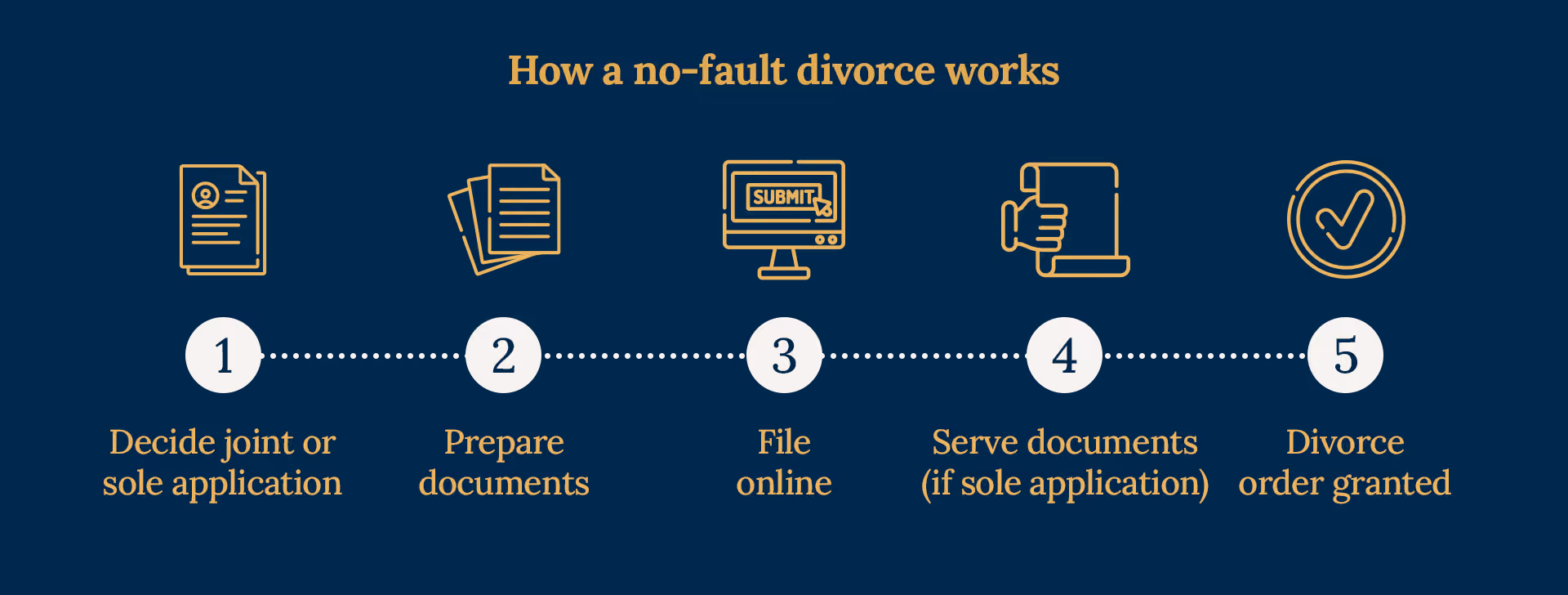
A no-fault divorce in Australia follows a standard federal process. The application is usually filed online, and the court focuses on whether the legal requirements have been met rather than why the marriage ended.
- 01

Step 1: Decide whether to apply jointly or alone
You can make a joint application with your spouse or a sole application on your own. A joint application is usually more straightforward because service is not required.
- 02

Step 2: Prepare your documents
Gather the documents needed for the divorce application, including your marriage certificate and any supporting evidence about separation if required.
- 03

Step 3: File the application online
Most divorce applications are filed electronically through the Commonwealth Courts Portal. You will need to complete the form and pay the filing fee unless you qualify for a reduced fee.
- 04

Step 4: Serve your spouse if applying alone
If you make a sole application, you must arrange for your spouse to be formally served with the divorce documents. You cannot serve the documents yourself.
- 05

Step 5: Attend hearing and receive final order
A hearing may be required in some cases, such as where there are children under 18. If the court grants the divorce, the divorce order usually becomes final one month and one day later.
Do you need to prove anything for a no-fault divorce?

Although Australia has a no-fault divorce system, you still need to prove certain legal requirements before a divorce can be granted. The court does not require evidence of wrongdoing, but it must be satisfied that a valid marriage exists and that the parties have been separated for at least 12 months.
Acceptable evidence may include:
- A marriage certificate showing that the marriage is legally recognised
- Information confirming that you have been separated for at least 12 months
- Affidavit evidence if you were separated under one roof during part or all of the separation period
- Proof of Australian citizenship, residency, or eligibility to apply in Australia, where required
- Evidence that divorce documents were properly served if you made a sole application
- Information about arrangements for any children under 18, where applicable
The focus of a divorce application is proving that the legal requirements have been met, not proving that one party was responsible for the end of the marriage.
Need help understanding your next step?
If you are considering divorce, early legal advice can help you understand your options, obligations, and what the process may involve.
What’s the difference between a no-fault and fault-based divorce?
Australia follows a no-fault divorce system, which means the court does not consider who caused the breakdown of the marriage. In contrast, some overseas jurisdictions still use fault-based divorce models, where one party must prove misconduct before a divorce can be granted.
The no-fault approach adopted under Australian family law is designed to reduce conflict and allow couples to divorce without having to prove blame or wrongdoing.
Do you need a lawyer for an uncontested divorce?

An uncontested divorce is often more straightforward than a disputed matter, and many people choose to handle the application themselves. However, legal advice can still be valuable, particularly if there are questions about eligibility, service requirements, children, or related family law issues. Getting the process right the first time can help avoid delays and unnecessary stress.

Clear guidance from experienced family lawyers
Carew Counsel has more than 40 years of experience helping individuals navigate divorce and family law matters. Our team can explain the process in plain English and help you understand your options.

Support with applications and documentation
Even simple divorce applications can involve technical requirements. We can assist with preparing documents, addressing court requirements, and resolving issues before they become obstacles.

Advice beyond the divorce itself
A divorce order is only one part of the picture. We can also provide guidance on parenting arrangements, property settlement matters, and other family law considerations that may affect your future.

Client-focused and cost-conscious approach
Carew Counsel is known for delivering practical advice that focuses on achieving efficient outcomes while avoiding unnecessary legal costs wherever possible.

Accredited family law expertise
Our team includes accredited family law specialists recognised as leaders in their field, giving you access to experienced advice tailored to your circumstances.

A roadmap for moving forward
Every situation is different. A consultation with our team can help you understand the steps ahead and provide a clear path forward based on your individual needs.
Can fault affect property or parenting arrangements?
Although Australia has a no-fault divorce system, this only applies to the divorce itself. The court does not consider who was responsible for the breakdown of the marriage when deciding whether to grant a divorce. However, certain types of conduct may still be relevant when dealing with parenting matters or, in limited circumstances, property settlement issues.
When making decisions about children, the court's primary focus is the child's best interests. Similarly, while property settlements are generally based on factors such as contributions and future needs, serious misconduct may indirectly affect the outcome if it has affected the family's finances or well-being.
Examples include:
- Family violence that affects parenting arrangements or a child's safety and well-being
- Financial misconduct, such as deliberately wasting assets or hiding property from the other party
- Behaviour that impacts a person's ability to care for children or meet parenting responsibilities
While fault is not a ground for divorce in Australia, the surrounding circumstances can still be relevant when resolving other family law matters.
When did no-fault divorce start in Australia?
No-fault divorce was introduced in Australia through the Family Law Act 1975, which came into effect on 5 January 1976. Before these reforms, couples seeking a divorce generally had to prove that one spouse was responsible for the breakdown of the marriage. The new system shifted the focus away from blame and towards whether the marriage had broken down irretrievably.
Key historical points include:
- The Family Law Act 1975 introduced Australia's no-fault divorce system.
- The requirement to prove misconduct, such as adultery or cruelty, was removed.
- The irretrievable breakdown of the marriage became the sole ground for divorce in Australia.
Get professional advice about a no-fault divorce
Understanding how no-fault divorce works can help you make informed decisions about your divorce, parenting arrangements, and property matters. While you do not need to prove wrongdoing to obtain a divorce in Australia, obtaining legal advice can help ensure you understand your rights, obligations, and options moving forward.
Table of contents